If you have ever searched for a “geyser” on Amazon India and gotten the same results as “water heater,” you have already stumbled on the core confusion that this water heater vs geyser debate creates for millions of buyers. These terms are not interchangeable everywhere. They mean different things in different countries, and in India specifically, they refer to meaningfully different types of hot water appliances with real differences in energy consumption, cost, and daily practicality.
In the water heater vs geyser conversation, the word “geyser” in India almost always refers to an instant or storage electric water heater installed in the bathroom. “Water heater” is the broader category that covers gas, solar, and heat pump systems as well. Understanding that distinction, and knowing when one type actually outperforms the other, is what this guide is about.
Why trust this guide: This article is written by Abdul Khader, who has spent over 4 years installing and repairing geysers in Indian homes across hard and soft water regions. The costs and lifespans below come from real installation and service visits, not just spec sheets.
Quick answer: In India, “geyser” almost always means a bathroom-mounted electric water heater, either instant or storage. “Water heater” is the wider category that also includes gas, solar, and heat pump systems. For most single people or couples, an instant geyser is cheaper to run, for daily family use, a 5-star storage geyser used with good habits usually wins on total cost and convenience.
Where the Word “Geyser” Actually Came From

The word traces back to a single hot spring in Iceland, Geysir, in the Haukadalur valley. In Old Norse, geysa meant “to gush.” When the British encountered these erupting springs in the 18th century, they borrowed the name.
When compact gas-powered water heaters arrived in Victorian-era Britain, devices that produced sudden bursts of hot water on demand, someone noticed the resemblance, and the name stuck. By the early 1900s, British plumbing manuals were already using “geyser” to describe bathroom water heaters.
When British plumbing conventions travelled to India and South Africa through colonial infrastructure, they brought the terminology with them. As documented by Wiktionary’s etymology records, the word “geyser” appeared in British plumbing texts as early as 1902 to describe instantaneous bathroom water heaters.
In South Africa, “geyser” now typically means a storage tank water heater and in India, it more often means an instant one. In the UK, the word is increasingly archaic, and in the United States, it was never adopted at all. Americans have always said “water heater.”
This linguistic patchwork is the root of most online confusion in the water heater vs geyser debate.
What “Water Heater” Actually Means
“Water heater” is an umbrella term. It covers every device that uses energy, whether electricity, gas, solar radiation, or heat pump technology, to raise the temperature of water for domestic use. That includes:
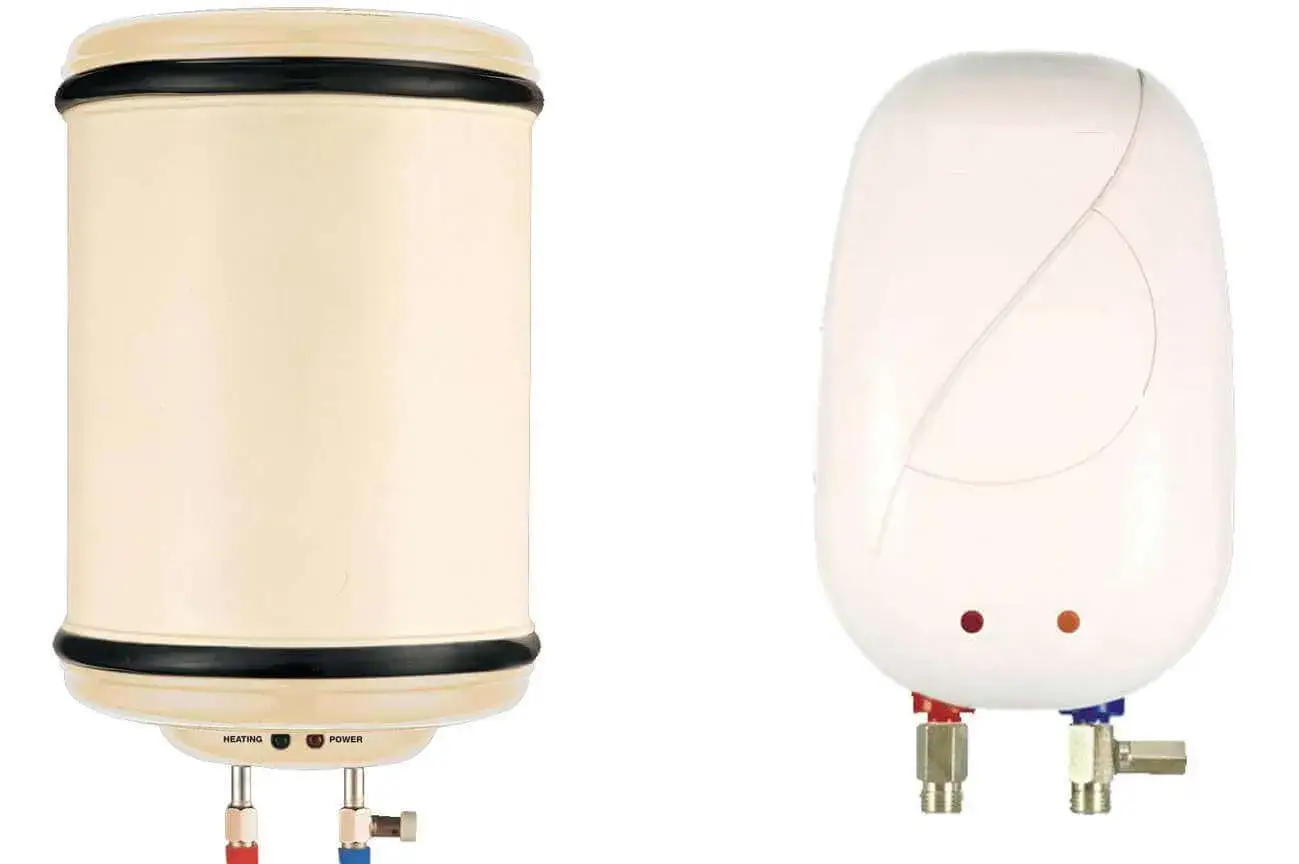
- Storage water heaters: an insulated tank (typically 10 to 25 litres for home use in India) that heats and holds water, keeping it warm until you need it
- Instant or tankless water heaters: no storage, heat water as it flows through a heating element, delivering hot water within seconds
- Gas water heaters: use LPG or PNG to heat water, faster recovery than most electric models
- Solar water heaters: roof-mounted collectors heat water using sunlight, feeding a storage tank
- Heat pump water heaters: extract ambient heat from the air to heat water, highly efficient but expensive upfront
All of these fall under the “water heater” category. Only some of them get called “geysers” in everyday Indian conversation, which is why the water heater vs geyser question confuses so many first-time buyers.
What “Geyser” Means in the Indian Context

In Indian homes and retail contexts, “geyser” typically refers to one of two things.
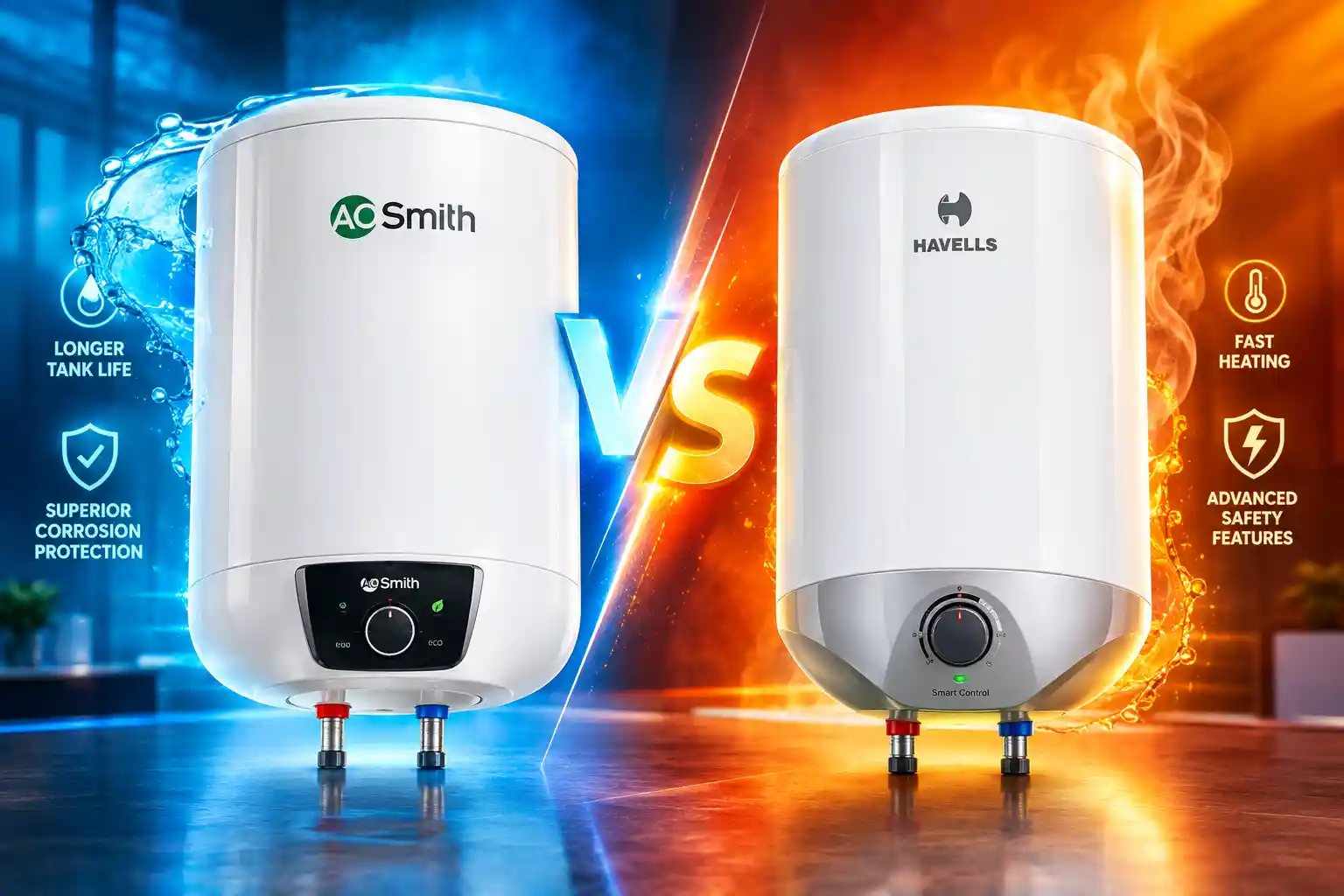
Instant Geysers (1 to 3 Litre Capacity): Wall-mounted units, often installed directly above the tap or shower. They have no storage tank. When you turn the tap, water flows through a heating element and comes out hot within seconds. These are the compact white boxes you see in hotel bathrooms and urban apartments. Brands like Racold Pronto, Havells Instanio, and AO Smith Xpress are standard examples.
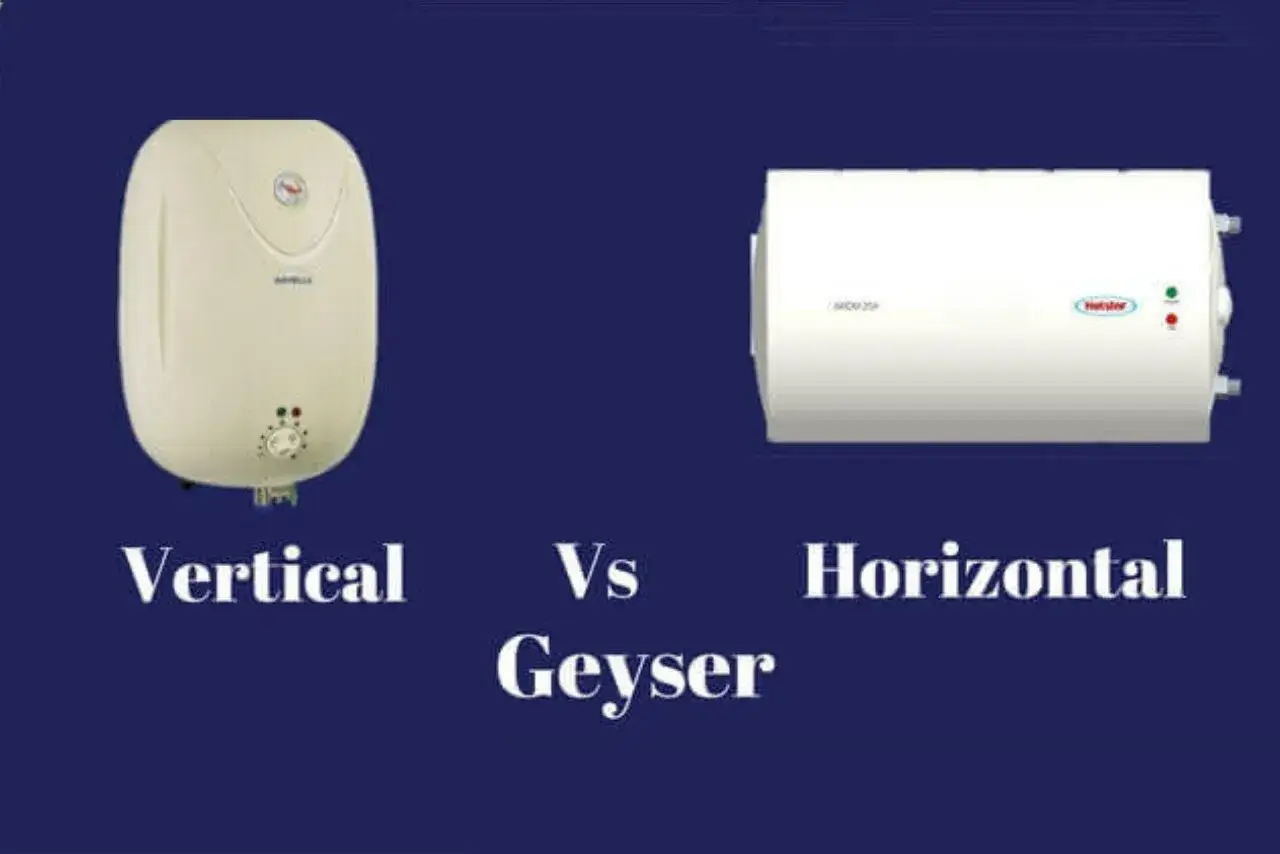
Storage Geysers (6 to 25 Litre Capacity): These have a tank, but in Indian retail language, they are often still called “geysers” rather than “water heaters.” A 15-litre Bajaj Shakti GL or a Crompton Arno Neo is technically a storage water heater. Walk into any electrical shop in Bengaluru or Lucknow and ask for a “geyser,” and the shopkeeper will show you exactly this.
When someone in India says “geyser,” they almost certainly mean an electric, bathroom-mounted hot water appliance. Solar systems and gas water heaters usually get their full names.
Water Heater vs Geyser: Storage vs Instant Comparison That Actually Matters
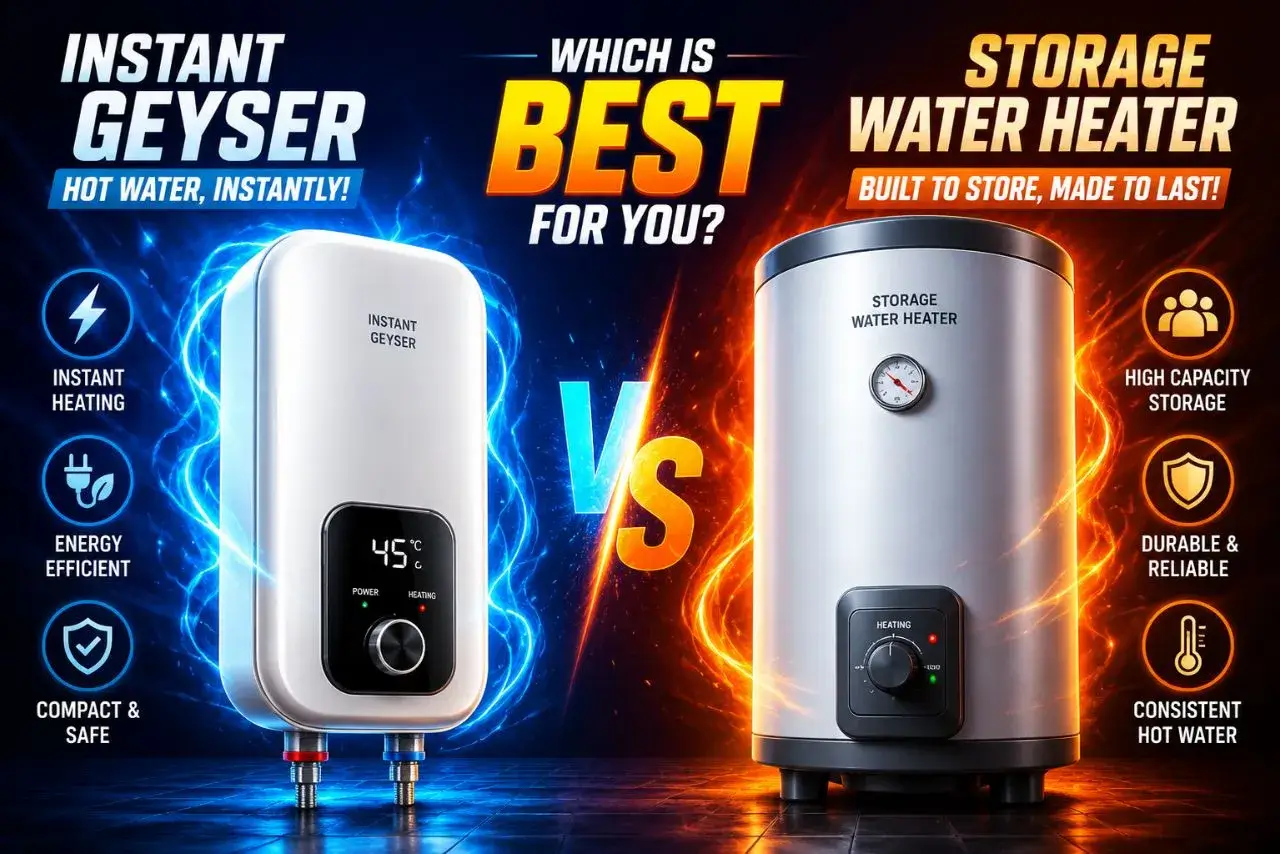
Beyond the terminology debate, most people researching water heater vs geyser are actually trying to decide between a storage unit and an instant one, our Instant Geyser vs Storage Geyser guide goes deeper into that specific decision. That is the decision with real consequences for your electricity bill, your morning routine, and your bathroom wall space.
How Each Type Actually Works
A storage water heater keeps a tankful of water heated to a set temperature, typically 60°C, continuously. The thermostat cycles the heating element on and off to maintain that temperature. When you open the hot tap, pre-heated water flows out, and cold water enters the tank to replace it.
An instant water heater does nothing until you turn on the tap. The moment water starts flowing, a flow sensor activates the heating element, usually rated between 2,000 and 3,000 watts, and water is heated as it passes through. When you close the tap, the element switches off completely.
Energy Consumption: What the Numbers Actually Show

This is where the water heater vs geyser decision becomes concrete. A 15-litre storage geyser rated at 2,000 watts, used for roughly 3 hours per day, including heating and standby re-heating, consumes about 6 kWh daily. At approximately Rs. 7 per unit, a reasonable average across Indian states in 2026, that works out to Rs. 42 per day and roughly Rs. 1,260 per month.
An instant geyser rated at 3,000 watts used for a 10-minute shower draws about 0.5 kWh for that session. For two people showering once daily, that comes to around 1 kWh per day, approximately Rs. 7 per day, or Rs. 210 per month.
The gap is significant. Instant geysers win on running cost because they carry zero standby heat loss. The storage unit is continuously burning electricity just to keep water warm for whenever you might need it.
That said, the comparison is not always this clean. If you use a storage geyser strategically, switching it on 20 to 30 minutes before use and off immediately after, the consumption difference narrows considerably. The problem is that most households do not maintain this habit consistently.
Where Storage Water Heaters Still Make Sense
For a family of four or more using hot water across multiple outlets, bathroom, kitchen, and washing, a single storage unit at 25 litres handles demand that would overwhelm an instant geyser’s flow rate.
Instant geysers typically supply 2 to 5 litres per minute of truly hot water. That is adequate for a single shower but inadequate for a large family with simultaneous demand. Storage heaters also work better in areas with low water pressure, where instant heaters may not trigger their flow sensors reliably.
The BEE Star Rating Factor
India’s Bureau of Energy Efficiency (BEE) rates storage water heaters on a 1 to 5 star scale. A 5-star 15-litre unit uses less electricity than a 3-star equivalent. Some premium models achieve their rating through thicker PUF insulation, which reduces standby heat loss and extends heat retention.
Certain models also feature a standby cutoff that draws under 1 watt when idle, adding up to meaningful savings over a full winter season. For storage geysers specifically, the BEE rating matters a great deal. For instant geysers, since standby loss is near zero by design, the star rating system is less critical, though wattage and build quality still affect efficiency.
Hard Water, Tank Material, and Why Your Geyser Dies Early

One topic that almost never gets covered in water heater vs geyser comparison articles: water quality is arguably more important than brand when it comes to geyser longevity in India.
Hard water, high in dissolved calcium and magnesium, causes scale buildup on heating elements and tank walls. This scaling acts as insulation, forcing the element to work harder and heat less efficiently. Over time, it causes element failure. In cities like Delhi, Chennai, Jaipur, and large parts of Maharashtra, hard water is standard.
When comparing water heater vs geyser options for these regions, tank material should be the first filter, not price. For hard water areas, these material choices make a lasting difference:
- Glass-lined tanks (enamel coating on the inner steel surface) resist corrosion and scaling better than plain steel. AO Smith and Racold use glass-lining in most mid-range and premium models.
- Titanium-coated or copper heating elements outlast cheaper nichrome elements significantly in mineral-heavy water.
- Magnesium anode rods inside storage tanks sacrifice themselves through galvanic corrosion, protecting the tank from rusting. These need replacement every 2 to 3 years in hard water zones, but most owners never do it, which is why many geysers fail well before their rated lifespan.
If you live in a hard-water city, the inner tank material matters more than the brand name on the outside. See our Geysers for Hard Water guide for a full maintenance schedule, and What is the Anode Rod Purpose for how to check and replace one yourself.
Gas Geysers: The Underused Option in the Water Heater vs Geyser Decision
In cities with reliable piped natural gas (PNG) infrastructure, parts of Mumbai, Surat, Pune, Ahmedabad, and expanding networks in Delhi NCR, gas water heaters deserve more consideration than they typically get.
A gas geyser heats water roughly three times faster than an electric storage unit. Recovery time, the time to reheat a depleted tank, drops from 20 to 30 minutes to under 10. For large families, this is a practical advantage, and gas units also work during power cuts, which in many Indian cities is not a trivial benefit.
The running cost is typically lower than electric, particularly for households with high hot water demand. The tradeoff is that gas geysers require either a PNG connection or LPG cylinders, adequate ventilation due to carbon monoxide risk in poorly installed units, and professional installation. They are not practical for apartments without piped gas, and the carbon monoxide risk from poor ventilation is a real safety consideration, not a footnote, see Are Gas Geysers Dangerous before deciding.
Indo PNG, Hindware, and Faber make gas geyser models commonly available in India. For households with PNG access and more than four members, a gas unit often makes more economic sense than either an electric storage or instant water heater vs geyser combination, though this is rarely the first thing a salesperson will suggest. Our Gas Geyser or Electric Geyser comparison covers the full trade-off.
Solar Water Heaters: When the Math Works

Solar water heaters are not “geysers” in common Indian parlance, but they belong in any serious water heater vs geyser discussion for anyone making a long-term purchase decision.
A rooftop solar water heater of 100 to 200 litre capacity works on the thermosiphon principle, meaning no pump and no electricity consumption. Water circulates naturally as it heats. For a household using 100 litres of hot water per day, a quality solar system can eliminate 90% of hot water electricity costs in cities with 250 or more sunny days per year. Most of peninsular India qualifies.
The upfront cost of Rs. 15,000 to Rs. 35,000 installed looks steep until you run the numbers. At Rs. 1,200 to Rs. 1,500 per month in electricity savings, payback typically happens in 18 to 30 months. Lifespan is 15 to 25 years, compared to 8 to 12 years for a good electric geyser.
The catch is that flat rooftop access is required. Hard water areas need evacuated tube collectors, which are more expensive but more durable than flat plate models in mineral-heavy water. Completely overcast weather requires a backup electric element. For apartment dwellers without roof access, solar is not an option. For those with a terrace or independent house in a sunny region, it is arguably the most financially sound hot water decision available.
Matching the Right Water Heater vs Geyser to Your Actual Situation
Rather than a blanket recommendation, here is a practical framework based on household type.
Single Person or Couple in an Apartment (Bucket Baths or Quick Showers): A 3-litre instant geyser handles this well. It has the lowest running cost and takes up almost no wall space. Models like Racold Pronto Neo or Havells Instanio 3L, priced between Rs. 2,000 and Rs. 3,500, are the practical choice.
Family of 3 to 4 in an Apartment (Daily Showers): A 15-litre 5-star storage water heater used strategically, timer-controlled or switched on 20 minutes before use, balances cost and convenience. See our geyser size guide to check this fits your actual usage, and how to reduce running cost for the habits that matter most. Budget Rs. 8,000 to Rs. 14,000 for a quality unit with a glass-lined tank.
Family of 5 or More or Multiple Simultaneous Users: A 25-litre storage geyser or, if PNG is available, a gas water heater. AO Smith’s EWS series and Racold’s Platinum Pro are among the more durable storage options at this capacity. If you are choosing between AO Smith and a more budget-friendly brand specifically, see our AO Smith vs Bajaj Geyser comparison.
Independent House with Terrace in a Sunny Region: Supplement with a solar water heater and use the existing electric geyser as backup only during the monsoon season.
Hard Water City (Delhi, Chennai, Jaipur): Prioritise a glass-lined tank and a titanium or copper heating element over brand name, and budget for anode rod replacement every 2 to 3 years.
A Quick Checklist Before You Buy
- Count how many people need hot water at the same time or back to back, this decides instant versus storage more than anything else.
- Test or ask about your water hardness. If it is hard, filter your shortlist to glass-lined tanks with titanium or copper elements first, before comparing price.
- Check your point’s wiring rating. A storage geyser needs a dedicated 16A MCB, a higher-wattage instant geyser may need 20A, confirm with an electrician before buying.
- For a storage geyser, check the BEE star rating and the warranty terms for what is actually covered, tank and element warranties often differ.
- If PNG is available and your household is large, get a gas geyser quote alongside the electric options and compare total cost including ventilation work.
- If you have usable roof access in a sunny region, price a solar water heater against 3 years of your current electric running cost before ruling it out.
- Confirm the brand has a service centre near your pincode before buying, not after something breaks.
Safety Details Most Buyers Miss

Electric water heaters operate at pressures and temperatures that cause serious accidents when installations go wrong. A few specifics worth knowing before you buy or install any unit.
The Pressure Relief Valve (PRV): This is not optional. Every storage geyser must have one installed and functional. It releases excess pressure if the thermostat fails and water approaches the boiling point. A blocked or missing PRV is a genuine explosion risk, so check that yours opens freely once a year.
Earthing: Geyser metal bodies must be properly earthed. Faulty earthing combined with a leaking tank causes electrocution. If your bathroom has a geyser and you have ever felt a mild tingle from the shower, get an electrician to check the earthing immediately. See Geyser Without Earthing for how to check it properly rather than assuming.
Separate Circuit: A 2,000-watt geyser draws about 9 amps. It should be on its own 16-amp MCB and not share a circuit with other heavy appliances. Undersized wiring here is one of the most common causes of a melted switch, see Why Does a Geyser Switch Melt for how to avoid it.
Never Switch On a Storage Geyser When the Tank Is Empty: A dry-run will burn out the heating element within minutes. Always fill the tank first by opening the hot tap until water flows steadily, then switch on.
The Bureau of Indian Standards (BIS) mandates safety certifications, including ISI mark compliance for electric geysers sold in India. When buying, verify the ISI mark, which confirms the product meets IS 2082 safety standards for electric storage water heaters.
What the Salesperson Will Not Tell You
A few things affect long-term satisfaction but rarely come up at the point of sale.
Warranty terms vary significantly. A “5-year warranty” on a storage geyser often covers only the tank. The heating element, thermostat, and other components may carry only a 1-year warranty. Read the warranty card before buying, not after.
Installation cost and quality matter as much as the unit itself. Poor installation, whether undersized pipes, improper earthing, or a missing PRV, causes most early failures. If the brand offers installation, use it. If not, pay a licensed electrician rather than the building’s general handyman. See our Geyser Installation Guide for exactly what a correct setup should include.
Brands like AO Smith, Racold, and Havells have relatively stronger service networks in Tier-1 cities. In smaller cities and towns, service availability matters more than brand prestige. A unit from a brand with no local service centre becomes a liability regardless of build quality.
Conclusion
The water heater vs geyser question has two distinct layers. The first is a language question: in India, a geyser is a water heater, just one specific bathroom-mounted electric type shaped by British colonial plumbing terminology. The second is a genuine buying decision between storage and instant types, each suited to different household sizes, usage patterns, and water quality conditions.
For most urban Indian households making this water heater vs geyser choice, an instant geyser serves a single person or couple best, keeping monthly running costs as low as Rs. 210. A 5-star storage water heater, used with manual control or a timer, suits families of three to four. Larger households benefit most from a high-capacity storage unit or, where PNG infrastructure exists, a gas water heater.
What cuts short a geyser’s life faster than any other factor is not the brand. It is hard water neglect, missing anode rod maintenance, and poor installation. Address those three things, choose your water heater vs geyser type based on actual household demand rather than price alone, and the appliance will deliver reliable hot water for a decade or more.
Frequently Asked Questions
1. Are “Geyser” and “Water Heater” the Same Thing in India?
Largely yes, but “geyser” in India typically refers specifically to an electric water heater installed in the bathroom, either instant or storage type. “Water heater” is the broader term that includes gas, solar, and heat pump options. The water heater vs geyser confusion is primarily a regional language issue rooted in British colonial plumbing conventions.
2. Which Uses Less Electricity, an Instant Geyser or a Storage Geyser?
An instant geyser typically uses significantly less electricity because it heats water only on demand with no standby heat loss. A storage geyser continuously maintains water temperature, consuming electricity even when no hot water is being used. The difference can be Rs. 500 to Rs. 1,000 per month, depending on usage habits and the insulation quality of the tank.
3. What Does the BEE Star Rating Mean for Geysers?
The BEE star rating indicates a storage water heater’s energy efficiency. A 5-star unit consumes significantly less electricity than a 3-star unit of the same capacity, primarily due to better insulation that reduces standby heat loss. Choosing 4-star or 5-star models in the water heater vs geyser comparison pays back the price premium within one to two heating seasons.
4. Which Brands Are Best for Hard Water in India?
For hard water areas, models with glass-lined inner tanks and titanium-coated or copper heating elements perform better over time. AO Smith (EWS series), Racold Platinum Pro, and Havells Monza Pro are commonly recommended for hard water durability. V-Guard and Venus also offer hard-water-specific models at lower price points.
5. Is a Gas Geyser Worth It If I Have a PNG Connection?
For households with 4 or more members and PNG access, yes. Gas geysers heat faster, recover faster, work during power cuts, and typically have lower running costs than electric storage geysers at high usage volumes. The installation requires professional work and real ventilation, since poor installation carries a genuine carbon monoxide risk, so weigh that alongside the cost savings rather than deciding on running cost alone. For the right household with that precaution taken seriously, it is a sound choice on the economics.
6. How Long Should a Geyser Last?
A well-maintained electric storage geyser should last 8 to 12 years. Instant geysers, with fewer wear-prone parts, can last similarly long. Accelerated failure usually comes from hard water scaling due to a neglected anode rod, dry-run damage, or poor installation. Replacing the anode rod every 2 to 3 years in hard water areas significantly extends tank life.
7. Can I Leave a Storage Geyser On All Day?
You can, but it is inefficient. The thermostat will cycle the element on and off throughout the day to maintain temperature, consuming electricity steadily even when the water is not being used. Switching it on 20 to 30 minutes before use and off immediately after is the most cost-effective habit with any storage water heater vs a geyser running on an electric system.