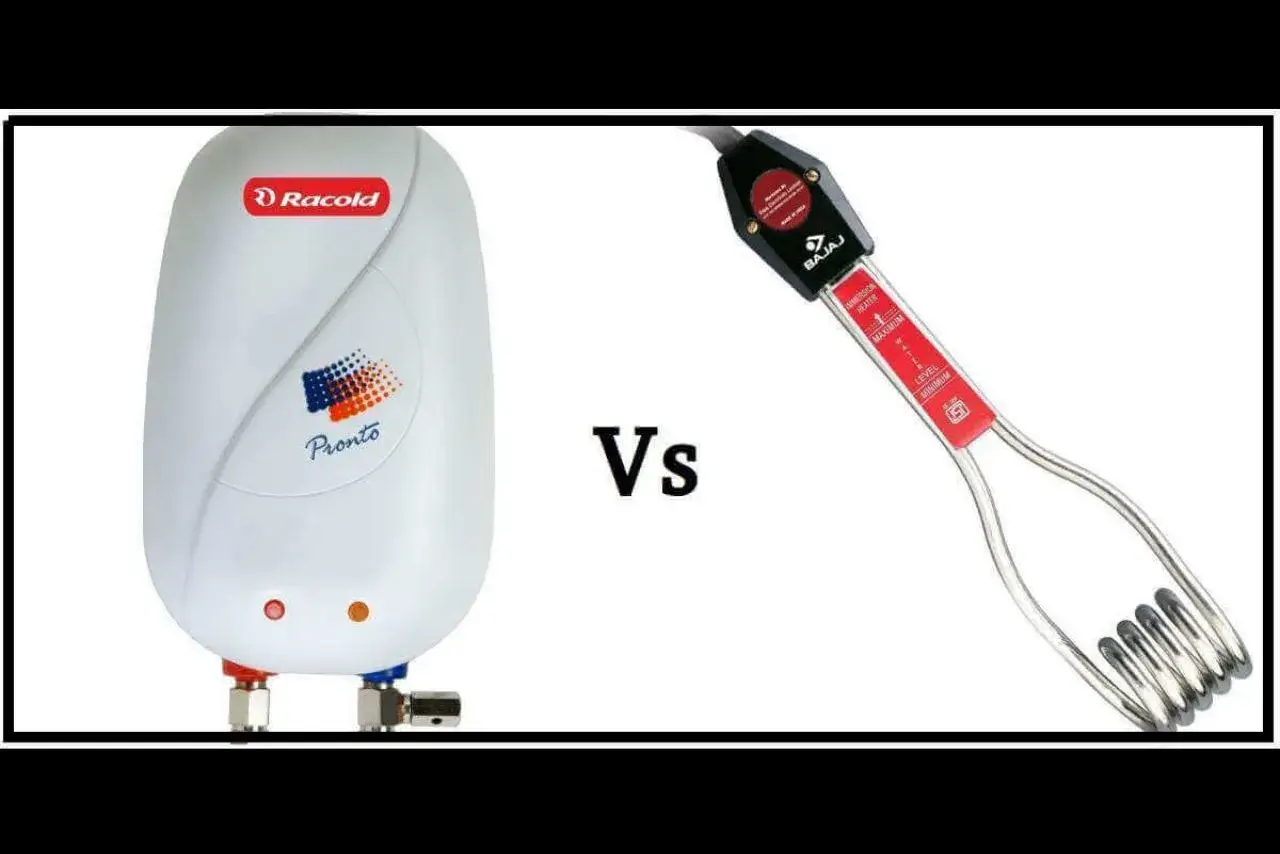
Still debating Geyser vs Immersion Rod? Learn which one saves electricity, gives faster hot water, and fits your budget perfectly.
Economical price of the Immersion Rod makes it a very alluring option compared to the Geyser. But Geyser has its own advantages. Let’s explore the Pros and Cons in detail.
Try to choose the right Geyser by answering simple questions without reading any Buying Guide.
Why trust this guide: This article is written by Abdul Khader, who has spent over 4 years installing and repairing geysers in Indian homes, and has handled his share of immersion rod mishaps too. The comparison below reflects real running costs and real safety incidents, not just spec-sheet claims.
Quick answer: For daily hot water in a family of two or more, a geyser works out cheaper and safer over time. For occasional use, a single person, or as a backup while your geyser is being repaired, an immersion rod is a fine, low-cost option, as long as you use it carefully.
Geyser vs Immersion Rod
| Feature | Immersion rod | Geyser |
|---|---|---|
| Price | Economical: Rs. 450 to 900 | More, depending on the model, up to 25 liters |
| Portable | Yes, helpful if you are moving houses | No |
| Water heating time | Takes more time to heat the water | Takes less time to heat the water |
| Hot water quantity | Limited to the bucket you fill | 10 to 25 litres, depending on the model |
| Safety | Risk of shock if the coating wears off or it’s used carelessly; not child-safe | Safer when properly earthed, but not risk-free either |
| Convenience | Difficult: Take some time to set up a bucket full of water and plug the rod | Easy: Just switch on |
| Auto off system | Not available | Available |
| Water heating method | Water is not heated uniformly | Water is heated uniformly |
| Bajaj, Havells, Racold, V-Guard, AO Smith, Kenstar, Crompton | Bajaj, Crompton Greaves, Usha, V-Guard, Maharaja | Bajaj, Havells, Racold, V-Guard, AO smith, Kenstar, Crompton |
| Example | Immersion Water Heater | Geyser Water Heater |
Immersion Rod Water Heater
How It Works
It is an extremely useful, economical way of heating the water. Immersion rod is a device used the heat the water. To heat the water, an immersion rod is installed in a utensil or a bucket along with water, and plug in the wall socket; that’s it.
Because of the immersion rod’s simple working principle and economical price, it’s quite popular in India. You can buy a branded immersion rod for less than Rs. 900 in India. The immersion rod consists of a coated metal rod.
Electricity passes through the rod as a result rod heats up, which further heats the water. The only problem is the coating on the rod, which insulates against the electric shock. In the course of duration immersion rod loses its coating and causes an electric shock. The immersion rod needs special care when handling it. It is not child-safe.
How to Use an Immersion Rod Safely
- Fully submerge the rod in water before switching it on, never switch it on outside water, even for a second
- Never touch the water or the rod while it’s plugged in and running
- Switch it off and unplug it before removing it from the bucket, not after
- Don’t leave it unattended, and never leave one running around children or pets
- Replace it the moment you notice the coating chipping, cracking, or wearing thin
- Use it only on a socket with proper earthing, ideally through an ELCB or RCD-protected point
Running Cost of an Immersion Rod
A typical 1.5 kW immersion rod uses roughly 0.75 units of electricity to heat a bucket in about 30 minutes, which works out to around Rs. 7 to 8 a day, or Rs. 225 to 240 a month, if used once daily. It has no standing loss since it only heats when you switch it on, which makes it genuinely cheap for occasional use. But it’s less efficient per litre than a geyser, so for daily use across multiple baths in a family, the electricity adds up faster than people expect.
Popular Geyser Articles
- Instant Vs Storage Geyser
- What is Gas Geyser?
- How to Use an Instant Geyser?
- Which Geyser Consumes Lowest Electricity?
- How to Clean a Geyser at Home?
- Why Does a Geyser Switch Melt?
Geyser Water Heater
How It Works
It’s a more useful but a little expensive solution to heat the water. A geyser basically contains a sealed metallic container and is mounted on the wall. A cold water pipeline is attached to the geyser inlet valve, and the geyser outlet valve is attached to the tap.
When cold water passes through the geyser, the heating element present in an inner container heats the water. The advantage of a geyser over its counterpart immersion rod, is that there is no need to set up the heater( like fill the bucket and plug the rod).
With a geyser, you can just switch on the electricity supply and after 5 to 10 minutes open the tap for hot water.
Is a Geyser Completely Shock-Safe?
A geyser is safer than a bare immersion rod dipped straight into a bucket, but it isn’t risk-free. Shocks do happen, usually from a missing or faulty earthing connection, a damaged switch, or a failing element. If your geyser has ever given even a mild tingle, don’t ignore it, our guide on Geyser Repair covers exactly when that’s a stop-and-call-a-technician situation.
Running Cost of a Geyser
A 3-litre instant geyser at 3 kW typically uses around 0.5 units of electricity per use, working out to roughly Rs. 150 a month with daily use, less than an immersion rod for the same job. Better insulation and an auto cut-off keep the running cost down even though the geyser itself costs more upfront. Over a year or two of daily use, that lower running cost usually makes up for the higher purchase price.
Which Should You Choose?
| Your Situation | Better Choice |
|---|---|
| Daily hot water for a family of two or more | Geyser |
| Single person, occasional use | Immersion rod |
| Renting, likely to move soon | Immersion rod |
| Backup while your geyser is being repaired | Immersion rod |
| Tight upfront budget, but daily need | Immersion rod short-term, geyser once you can afford it |
Frequently Asked Questions
Can I use an immersion rod every day instead of buying a geyser?
You can, but daily use across a family adds up in electricity cost faster than a geyser would, and it means handling a live electrical device near water every single day. For daily use, a geyser is usually the safer and cheaper choice long term.
Which one heats water faster?
A geyser, generally. An instant geyser gives you hot water in a couple of minutes, while an immersion rod takes 15 to 30 minutes to heat a bucket, depending on its wattage.
Is it safe to leave an immersion rod on overnight?
No. Switch it off and unplug it as soon as the water is hot enough. Leaving it running unattended is one of the main causes of immersion rod accidents.