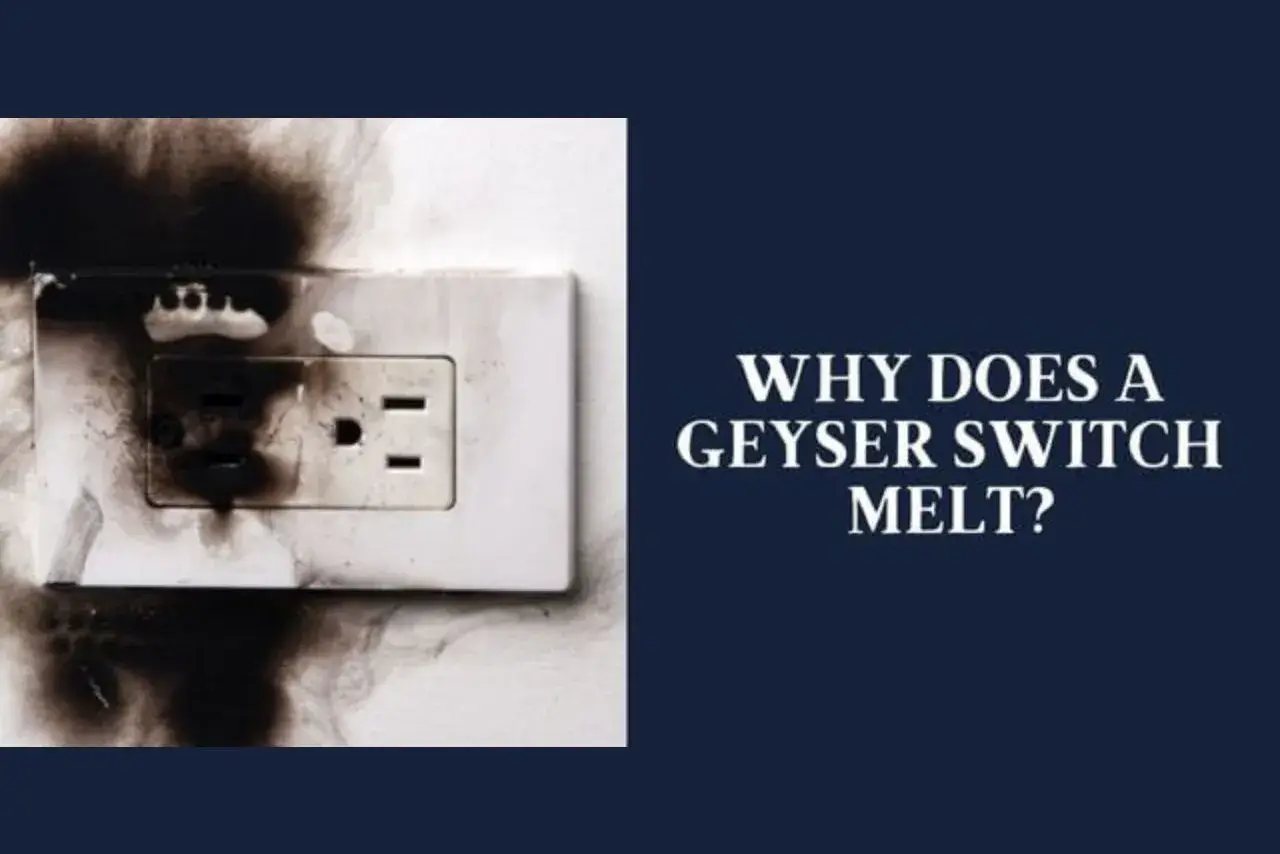
To prevent the switch/socket from melting/burning, make sure to use a switch with the correct wattage/ampere rating, replace old, worn out switch/sockets and wires, use high-quality branded bras made switch/sockets, avoid overloading the circuit, isolate the wiring from the main board toGeyser, no other appliance must and should not run on the same circuit, check and tighten any loose connection and most important always keep switch and wiring dry. It is always better to consult a professional electrician for electrical repairs.
Why trust this guide: This article is written by Abdul Khader, who has spent over 4 years installing and repairing geysers in Indian homes and has seen this exact problem more times than almost any other electrical fault on a service call. The ampere calculations and warning signs below are what actually get checked when a switch has melted.
Quick answer: Almost always, an undersized switch or socket for the geyser’s wattage, or a loose, corroded connection generating excess heat. Match the switch rating to the geyser’s actual wattage and keep every connection tight, and this stops being a recurring problem.
Try to choose the right geyser by answering simple questions without reading any Buying Guide.
How to Prevent a Geyser Switch from Melting
- Use a switch or socket with the correct wattage and ampere rating for your specific geyser
- Replace old, worn-out switches, sockets, and wiring rather than reusing them with a new geyser
- Use high-quality, branded, brass-made switches and sockets rather than the cheapest available
- Avoid overloading the circuit, no other appliance should share the geyser’s circuit
- Use isolated, dedicated wiring from the main board to the geyser
- Check and tighten any loose connections periodically
- Keep the switch and wiring dry at all times, moisture is one of the most common causes of corrosion here
It is always better to consult a professional electrician for electrical repairs rather than attempting them yourself. Our Geyser Installation Guide covers what correct wiring and switch setup should look like from day one.
Try to choose the right geyser by answering simple questions without reading any Buying Guide.
Actually, a Wrong Ampere ( amp ) Switch or a Socket ( Overloading )
If your geyser switch is rated for a certain wattage, connecting an appliance that consumes more power than the switch can handle can cause it to overheat and melt or burn. Ampere (A) is the measurement of calculating Switch/socket electricity handling capacity (Hopefully, non-technically satisfiable definition).
Every switch/socket had a certain ampere, which is directly related to your Geyser’s Wattage. For wattage and info, check your Geyser user manual or check it on the Amazon page. Wattage differs from one Geyser to another. In general switch/socket, the actual ampere capacity of a switch/socket is 80% of the given amperes; this is known as Safe Max Ampere.
             Geyser’s Watts
Ampere =   ------------------------
	     Electricity Voltage
For example, Geyser wattage is 3000 Watts (3 Kilowatts), and in India standard household electricity supply voltage is 220V
Ampere = 3000/220 = 13.6A
For 13.6A, the nearby Safe Max Ampere is 16A, with respect to the 20A switch/socket. This means for a 3000 Watts Geyser, go for a 20A switch/socket. Anything else less than a 20A switch/socket will burn/melt and cause an electrical hazard in the future.
For example, Geyser wattage is 2000 Watts (2 Kilowatts)
Ampere = 2000/220 = 9A
For 9A, the nearby Safe Max Ampere is 12.8A, with respect to the 16A switch/socket. This means for a 2000 Watts Geyser, go for a 16A switch/socket. Anything else less than a 16A switch/socket will burn/melt and cause an electrical hazard in the future.
Geyser’s Wattage
So above calculation helps to choose a suitable switch/socket depending on the Geyser’s wattage. Most of the time, people replace old Geysers with new ones without bothering about the electric switch/socket. For instance, the old Geyser is 2000 watts and was running on a 16A switch/socket.
Whereas, the new Geyser is of 3000 watts, which needs a 20A switch/socket. Due to a lack of knowledge, people don’t replace switches/sockets. However, the old switch/socket(16A) works well for a few days after that, it burns/melts and becomes useless as well as hazardous.
So in Conclusion, if the Geyser switch/socket burns/melts, first check switch/socket ampere is suited to the Geyser wattage or not. If not, replace immediately switch/socket.
Frequently Asked Questions
What ampere switch do I need for a 3000 watt geyser?
A 20A switch or socket, since a 3000 watt geyser draws around 13.6A, and a 20A switch’s safe max ampere of 16A comfortably covers that.
Is it safe to keep using a geyser after its switch has melted once?
No. A melted switch should be replaced, not reused, even if it still technically works. The underlying cause, usually an undersized rating or a loose connection, will keep generating heat until it is fixed.
Can a wrong-sized switch actually start a fire?
Yes. Sustained overheating at a switch or socket is a genuine fire risk, not just a cosmetic issue, which is why this is worth fixing as soon as you notice warning signs rather than after it has already melted.
Related Searches
People researching this topic also search for: geyser switch melting causes, correct ampere for geyser switch, geyser socket burning fix, geyser wiring safety, geyser switch fire hazard, geyser MCB and switch rating, and how to calculate geyser ampere.
Popular Geyser Articles
- Instant Vs Storage Geyser
- What is Gas Geyser?
- How to Use an Instant Geyser?
- Which Geyser Consumes Lowest Electricity?
- How to Clean a Geyser at Home?
Old and Worn-out Switch:
Over time, Switches/sockets become old, worn out, corroded, or damaged. As a result, it loses handling capacity. This makes excessive heat buildup, which causes melting and burning.
Low-quality switches are made of iron-like metals, which can be easily corroded by moisture, leading to a short circuit and overheating. So always go for a brass-made made branded, and perfectly suitable ampere switch.
How to Spot Corrosion Before It Becomes a Problem
Every few months, take a quick look at the switch faceplate for a greenish or white powdery residue around the screws or edges, that is early corrosion. In a bathroom, humidity speeds this up more than in any other room in the house, which is exactly why bathroom-rated, brass-made switches hold up so much better than cheaper iron-based ones over time.
Old and Worn-out Geyser:
Over time, salt and scaling formation on the Geyser tank and wear and tear cause the Geyser to consume more electricity than specified. This more electricity consumption burns/melts the old switch. In this case better to go for a new switch/socket with a slightly higher ampere ( Not recommended )
Incorrect Wiring/Loose Connection:
Incorrect wiring from the MCB main board to the Geyser, like Geyser wiring shared with other appliances ( Always must and should be isolated wiring to the geyser ), very thin wiring, damaged, and old wires. All this causes arcing, sparking in switches/sockets, and generating excessive heat.
Electrical Short Circuit:
Short circuits can occur due to damaged wires or electrical insulation, which causes electricity to flow through unintended paths, generating heat and possibly causing the switch to melt.
High Voltage:
Due to a malfunction in the grid power supply makes wires get warm and switch, and sockets melt down. In this case, you won’t use a Geyser as well as any other electric appliance, as it might damage the appliance as well as become a safety hazard. Better to contact a professional electrician immediately.
Early Warning Signs Before a Switch Fully Melts
A switch rarely melts without warning. Catch it at this stage and you avoid the bigger problem entirely:
- Discoloration or browning around the switch or socket faceplate
- The switch feels warm or hot to touch, even briefly after use
- A faint burning or plastic smell near the geyser point
- A buzzing or crackling sound from the switch when the geyser is on
- The switch feels loose or the plug does not sit firmly in the socket
Any one of these is worth switching off the geyser and getting an electrician to check it, rather than waiting to see if it gets worse.
If You See Sparks, Smoke, or Active Melting
This is not a wait-and-watch situation. If you see sparks, smell burning, or notice smoke or active melting at the switch:
- Switch off the geyser’s circuit breaker at the distribution board immediately, do not just flip the wall switch.
- Do not touch the switch, the geyser body, or any metal taps or pipes connected to it, a fault here can make plumbing fixtures live.
- Call an emergency electrician the same day, this is not something to leave until the weekend.
- Do not attempt to use the geyser again until it has been inspected and the switch or wiring replaced.
This kind of fault often overlaps with earthing problems. If you are not certain your geyser is properly earthed, our Geyser Without Earthing guide covers how to check.