No water coming from your geyser usually means one of two different problems: either no water is flowing at all, or water is flowing but it is not getting hot. They have different causes and different fixes, so the first step is figuring out which one you are actually dealing with.
Why trust this guide: This article is written by Abdul Khader, who has spent over 4 years repairing geysers in Indian homes and has diagnosed this exact complaint many times, often over the phone before ever seeing the unit. The checks below are the same ones used to narrow down the cause on a real service call.
Quick answer: If there is no water at all, check the inlet valve and your home’s main water supply first. If water is flowing but cold, check the MCB and the reset button before assuming the heating element has failed.
Try to choose the right geyser by answering simple questions without reading any Buying Guide.
No Water Flow at All (Not Even Cold)
Check the Basics First
Before assuming anything is broken, rule out the obvious. Check that your home’s main water supply is actually on, and that the cold tap at the same point gives water. If the cold tap is also dry, the problem is with your building’s water supply, not the geyser.
Closed or Faulty Inlet Valve
A partially or fully closed inlet valve is one of the most common causes, and one of the easiest to miss. Make sure the valve feeding the geyser is turned fully open. If it has been fully open and there is still no flow, the valve itself may have failed internally and need replacing.
Clogged Inlet Filter or Airlock
Sediment can build up enough to block the inlet filter mesh almost entirely, especially in hard water areas. Trapped air in the line can also stop flow, particularly after any recent plumbing work. Our How to Increase Geyser Water Pressure guide has a full checklist for both of these that applies here too.
Water Flows But It Is Not Hot
Power Supply and MCB
Check the power indicator light on the geyser first. If it is off, check whether the geyser’s dedicated MCB has tripped, and test the socket with another appliance to rule out a dead power point. A breaker that trips again immediately after being reset points to a short circuit, and that is a job for a technician, not something to keep resetting.
Tripped Reset (ECO) Button
Most geysers have a high-temperature reset button, sometimes labeled ECO, that trips as a safety measure if the water gets dangerously hot. Pressing it once to restore power is fine. If it trips again within a day or two, that usually means the thermostat is stuck or the heating element is failing, and it is worth calling a technician rather than continuing to reset it.
Faulty Thermostat or Heating Element
If the power light is on, the MCB has not tripped, and the reset button has not fired, but the water is still cold after 20 to 30 minutes, the thermostat or heating element has likely failed and needs replacing. Our Geyser Repair guide covers what that typically costs.
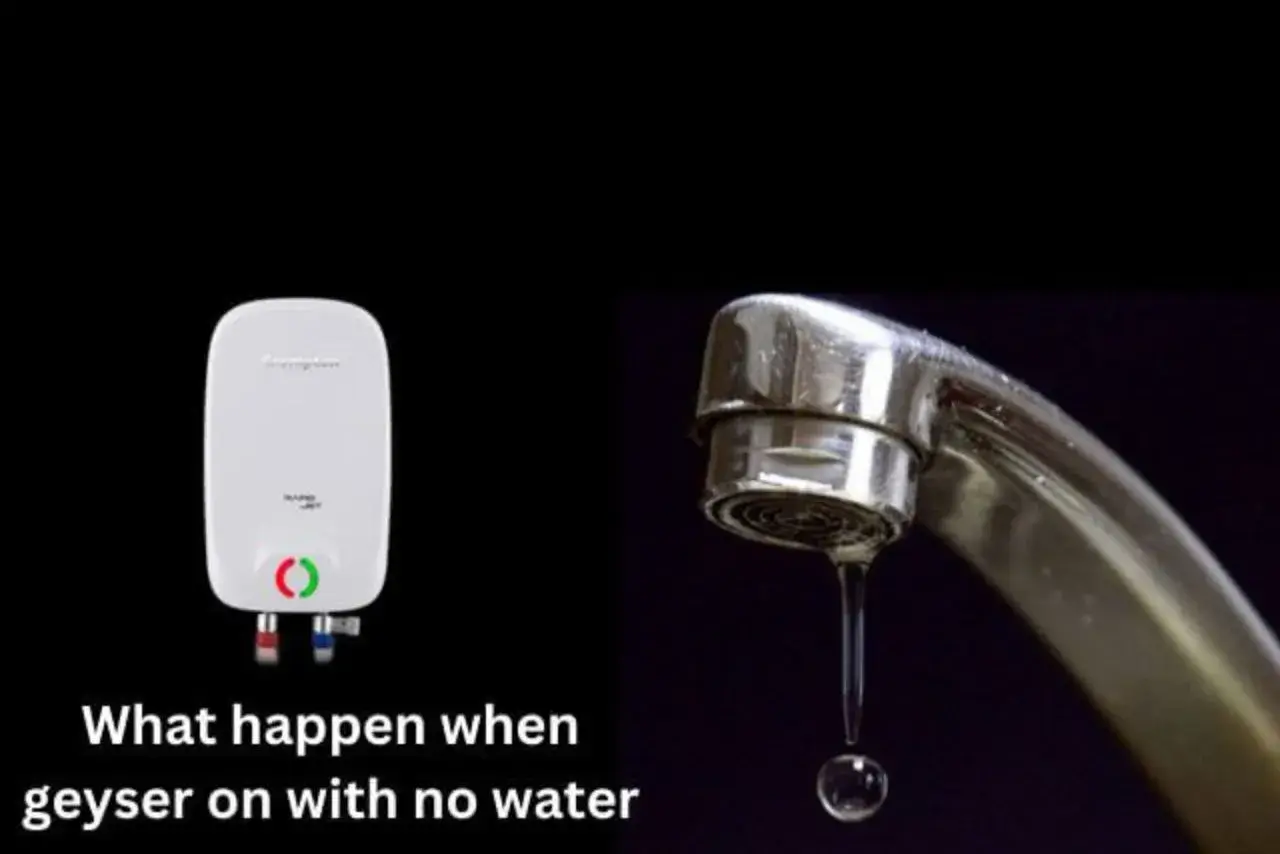
What will happen in an Electric Geyser if there is no Water in the Geyser Tank?
In general, the thermostat is a device that senses the geyser’s inner tank temperature. When it senses that the water has reached a certain temperature, it cuts off the electricity supply. If the geyser is switched on without water in the tank, the heating element instead heats the air around it.
Eventually, it heats the inner tank, whereas the thermostat senses the inner tank temperature and cuts off the electricity supply to avoid overheating.
After a certain time, when the inner tank temperature comes down, the thermostat allows the electricity supply again, and it heats the tank; this will go on. This will reduce the geyser’s lifetime and impact on the inner tank’s performance.
But the problem arises when the thermostat is malfunctioning/not working properly, it overheats the dry tank, which causes the heating element to overheat and burn out, which can lead to damage to the geyser and potentially cause a fire.
In the unfortunate event, the geyser might be blasted. Most of the time thermostat will take care of this type of situation. Our recommendation is to avoid this situation.
- Always check that water is flowing before switching on the geyser.
- Do not leave the geyser switched on for long stretches when it is not in use.
- Always check the geyser is switched off before leaving the house.
Frequently Asked Questions
Why is there no hot water after a power cut?
A power cut often trips the geyser’s thermal cutout or reset button as a safety measure. Check and reset the circuit breaker or the reset button on the unit once power is back.
How long should a geyser take to heat water?
A small instant geyser usually heats water within a minute. A storage geyser typically takes 10 to 20 minutes to bring a full tank up to temperature, depending on its wattage and capacity.
Can low voltage cause no hot water?
Yes. Voltage below around 200V can prevent the heating element from working efficiently, which can feel like the geyser is not heating at all when it is actually just heating very slowly.
Is it dangerous to keep resetting a tripped geyser?
If it trips once, resetting it is fine. If it keeps tripping, that is a warning sign of a deeper fault, and repeatedly resetting it without getting it checked risks a bigger failure later. See our Geyser Repair guide for when to call a technician.
Related Searches
People researching this topic also search for: geyser no hot water fix, geyser not heating after power cut, geyser MCB tripping repeatedly, geyser reset button keeps tripping, geyser low voltage problem, geyser water flow blocked, and geyser thermostat not working.
Popular Geyser Articles
- Are Gas Geysers Dangerous
- What is Gas Geyser?
- How to Use an Instant Geyser?
- Which Geyser Consumes Lowest Electricity?
- Is Gas Geyser Legal in India?