Once you know the capacity and Geyser type, you can choose between a vertical vs horizontal geyser. In this guide, we explore the pros and cons of both approaches. At the end, you will get clarity on taking a horizontal vs vertical geyser.
Try to choose the right geyser by answering simple questions without reading any Buying Guide.
Why trust this guide: This article is written by Abdul Khader, who has spent over 4 years installing and repairing both vertical and horizontal geysers in Indian homes. The trade-offs below reflect what actually happens after installation, not just spec-sheet claims.
Quick answer: If your bathroom has at least 2 feet of clear wall height, go vertical, it heats faster, costs less, and is easier to service. Choose horizontal only if a false ceiling, low loft, or attic genuinely won’t fit a vertical unit.
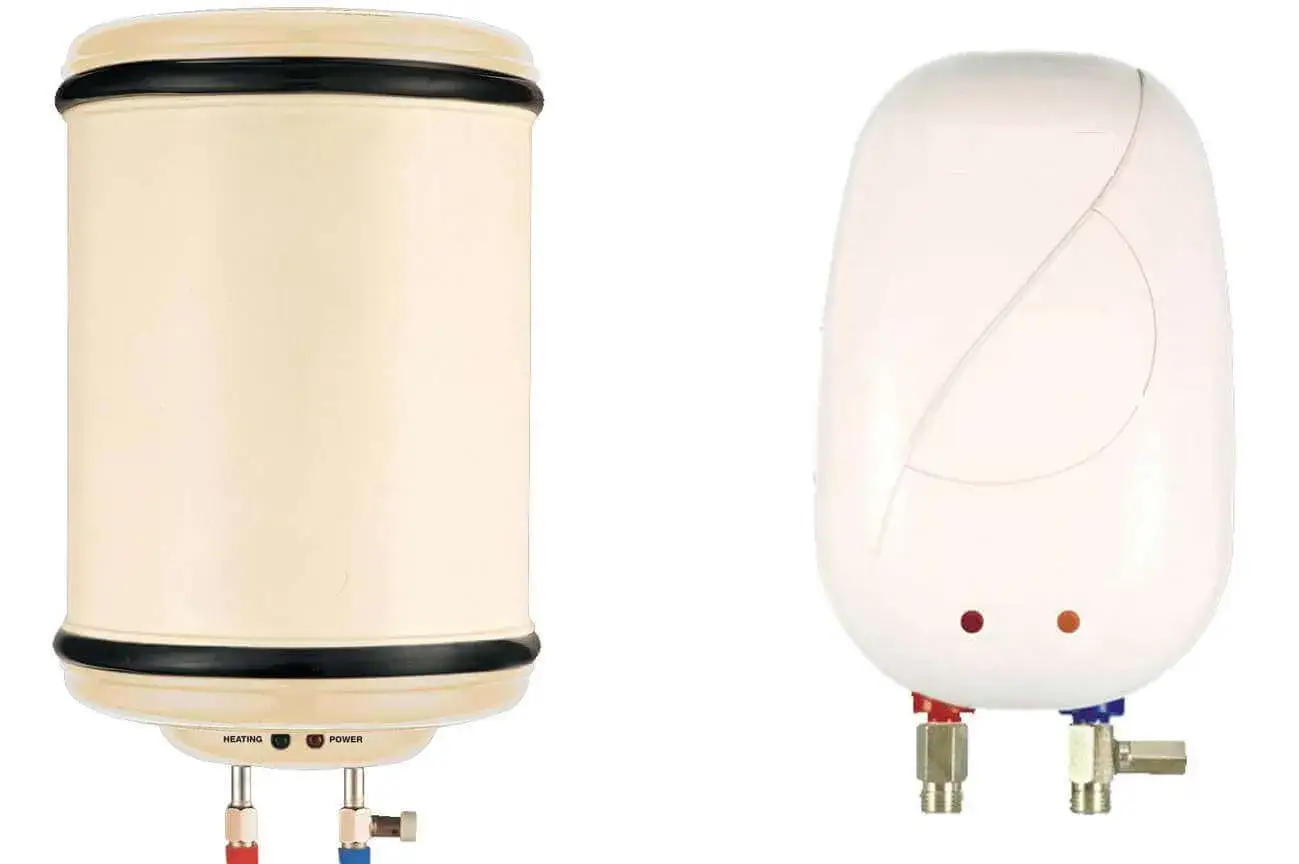
Traditionally, Geyser water heaters are vertically mounted. Horizontally mounted geysers are new to the market. For electric instant Geysers come only in a vertical mounting style. There are no horizontal instant geysers in the market.
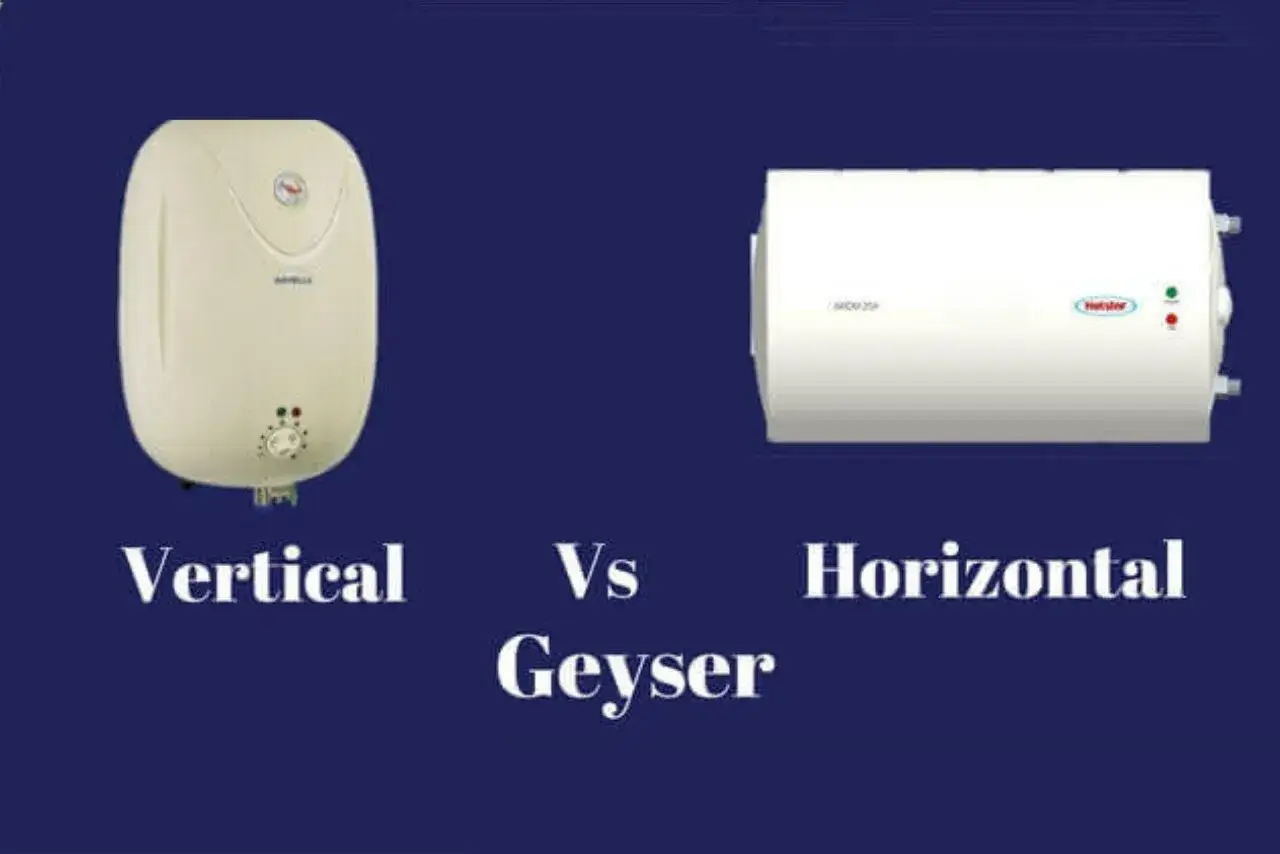
The reason is that instant geysers take so little space on the wall, and there is no point in changing the mounting style. The stored geysers with at least 15 litres capacity come in two flavours – vertical geysers and horizontal geysers. These are also known as V-Wall geysers and H-Wall geysers. A table with short differences is given below.
| Feature | Vertical Geyser | Horizontal Geyser |
|---|---|---|
| Requirement | Needs vertical wall space | Needs horizontal wall space instead |
| Price | Cheaper | 20–30% costlier for the same capacity |
| Aesthetics | Looks ok | Looks beautiful, sits flush against low walls |
| Energy efficient | Best efficiency in heating | Moderate efficiency in heating |
| Hot water availability | Delivers hot water even when the tank isn’t full | Tank needs to be at least half full before it can deliver hot water |
| Installation | Easy, most plumbers can do it | Trickier, needs a plumber experienced with horizontal units |
| Example | Bajaj New Shakti Neo 15L Vertical Geyser | AO Smith HAS-X1-025-RHS Storage 25 Litre Horizontal Geyser |
When to Choose Horizontal Geysers?
Vertical geyser water heaters require at least two feet of vertical length on the wall. If your bathroom ceiling is low, you have decorated with a false ceiling, or have an attic, then you won’t have enough vertical space on the wall to mount the geyser vertically. In this case, horizontal geysers make sense.
Apart from that, horizontal electric geysers aesthetically look very beautiful in the bathroom. While installing a horizontal geyser, make sure there is enough space adjacent to attend to minor repairs. It is a very bad installation if, even for minor repairs, you need to unmount the geyser from the wall. Confirm with the plumber whether they have expertise in installing horizontal electric geysers, as it is little difficult compared to vertical and requires little expertise.
Popular Geyser Articles
- Instant Vs Storage Geyser
- Geyser Installation Guide
- Geysers for Hard Water
- Instant Geyser for Bathroom?
- Winter is Coming! Is your Geyser Ready?
Horizontal Geysers vs Vertical Geysers
If you have sufficient space on the wall, you can choose between horizontal and vertical. The real question is whether I have space to install both types of electric geysers, and then which one to consider.
Traditionally, electric geysers are vertically mounted, and it is a natural method as well. Horizontal geysers are introduced to address space constraints. It is believed that Vertical electric geysers are more efficient. The reason is stratification. Stratification is a measure of the ease of mixing cold and hot water. The explanation is as follows.
Hot water has less density, so it tends to go to the top of the water tank of the geyser. The cold water stays at the bottom. When both waters mix, there is some turbulence and friction when water is pushed out of the geyser. This turbulence is less in the vertical geyser model compared to the horizontal model. So water is dispersed very easily in the vertical model.

Apart from that, vertical models are generally considered energy efficient. This is a general opinion, but few horizontal manufacturers can go beyond and try to achieve efficiency. Pricing is another criterion.
Horizontal electric geysers tend to be costlier than vertical electric geysers. The price difference goes from 20 to 30%. For example, AO Smith 15-liter vertical geysers’ price is around Rs. 7,000, whereas the horizontal ones’ price is around Rs. 9,000. Gas geysers usually do not come in horizontal models.
Hot Water Availability: A Detail Most Buyers Miss
In most horizontal geysers, the outlet sits roughly in the middle of the tank. That means the tank needs to be at least half full before hot water can reach the outlet, so if you’re running low, you may get a burst of hot water followed by nothing. A vertical geyser doesn’t have this problem, since water flows out by gravity and the outlet setup lets it deliver hot water even when the tank isn’t completely full.
Running Cost: Standby Heat Loss
A storage geyser keeps water hot even when nobody’s using it, and that idle heat loss is called standby loss. Vertical tanks hold on to heat more efficiently because the hot layer stays near the top, away from the cooler surface below. Horizontal tanks mix hot and cold water more easily, which pushes standby loss higher and can add a bit to your electricity bill over the years, on top of the higher upfront price.
Bajaj, Havells, Racold, V-Guard, AO Smith, Kenstar, and Crompton are well-known brands with varying capacities like 10 ltr, 15 ltr, and 25 ltr. You can buy these electric geysers online from Amazon and Flipkart.
Frequently Asked Questions on Vertical vs Horizontal Geyser
Can a vertical geyser be installed horizontally, or vice versa?
No. The two are built differently inside, not just mounted differently. A vertical geyser’s heating element, thermostat, and outlet are positioned assuming water sits and stratifies top to bottom; laid on its side, part of the element can end up above the waterline and burn out, or the thermostat can misread the temperature. A horizontal geyser has its element and outlet positioned for side-mounting, so standing it upright causes the same kind of problem in reverse. Installing either one the wrong way also voids the warranty, since manufacturers test and certify them only in their intended orientation.
Does a horizontal geyser need more maintenance than a vertical one?
Slightly, yes. Servicing a horizontal unit usually takes more effort since some models need to be partly or fully unmounted to reach internal parts, which is why the guide above stresses leaving clear space around it during installation. A vertical geyser’s element and anode are easier to access without disturbing the mounting.
Is a horizontal geyser worth the extra cost?
Only if you genuinely don’t have the wall height for a vertical unit. If you do have the space, a vertical geyser gives you faster heating, lower standing losses, and a lower price, so the horizontal option is really a space-constraint solution rather than an upgrade.